

![[headshot] image of customer (for a pr firm)](https://cdn.prod.website-files.com/69232909ef27bc15ca57c9ec/692415a73f3948330046438a_linkedinprofilephoto.png)
Direct Response Copywriting for SaaS: The Definitive Guide to Converting More Customers
Most SaaS companies are leaving 80% of their potential revenue on the table because they've forgotten the single most powerful marketing principle ever discovered.
After writing over 1,100 articles in the B2B SaaS space for the last 6 years, I've seen one pattern repeat itself: the fastest-growing companies aren't the ones with the fanciest features, but the ones who master the art of direct response. Instead of chasing the latest marketing fad, we'll apply 60+ years of proven and tested psychological principles from legends like Eugene Schwartz, Gary Halbert, and Claude Hopkins to the unique challenges of SaaS.
In this guide, I'm not just going to tell you what to do. I'm going to show you how to do it, with the exact frameworks, formulas, and examples I've used to help SaaS companies add millions in ARR.
What is Direct Response Copywriting (And What It's Not)?
Direct response copywriting is salesmanship in print, designed to elicit an immediate, measurable action. Think of it as the difference between a billboard that says "Coca-Cola: Open Happiness" and a late-night infomercial that screams "Call now and get two for the price of one!" One builds a feeling while the other demands a response.
While brand marketing builds awareness and emotional connections over time, direct response builds revenue right now. In a world of rising Customer Acquisition Costs (CAC) and fierce competition, every word needs to justify its existence with ROI. The global SaaS market is projected to grow from $315.68 billion in 2025 to over $887 billion by 2030, and the companies that will capture that growth are the ones that can convert traffic efficiently.
Here's how they differ:
As the legendary copywriter Claude Hopkins famously said:
"The only purpose of advertising is to make sales."
With the average SaaS company spending at least 35% of their revenue on sales and marketing, you can't afford to waste a single dollar on copy that doesn't convert. Direct response gives you the framework to ensure every headline, every email, and every landing page is working as hard as possible to drive revenue.
The Holy Trinity of Direct Response: Lessons from the Masters
The Schwartz Method: Channeling Your Customer's Deepest Desires
Eugene Schwartz, author of the legendary "Breakthrough Advertising," is a titan of the copywriting world. His book, originally published in 1966, is so valuable that used copies have sold for over $900 on Amazon. His core principle is that copy cannot create desire, but channels it.
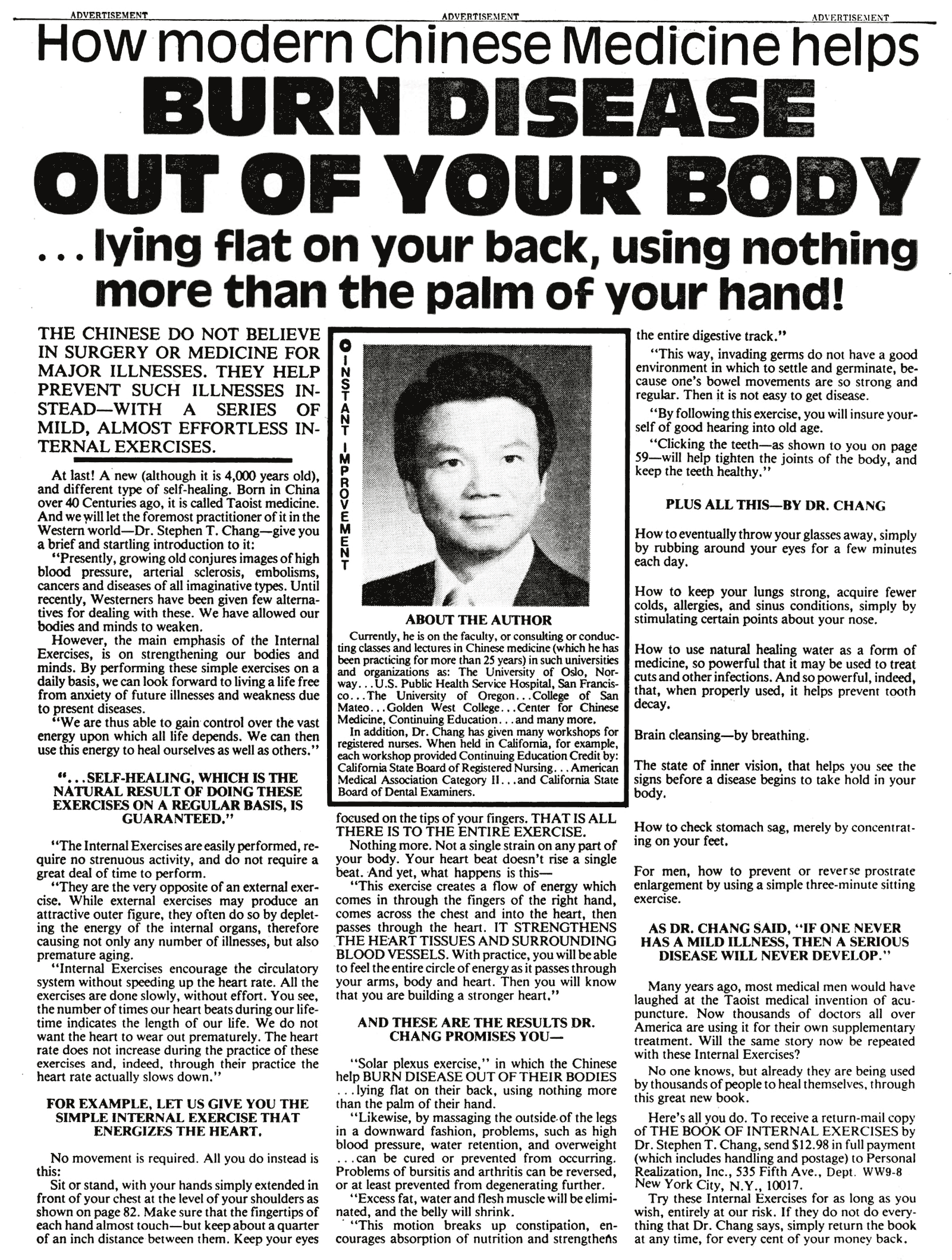
"Copy cannot create desire for a product. It can only take the hopes, dreams, fears and desires that already exists in the hearts of millions of people, and focus those already existing desires onto a particular product."
This is a radical idea that most marketers get wrong. They think their job is to convince people to want their product. Schwartz says that's impossible. Your job is to find people who already want what you're selling and show them that your product is the answer.
I've seen this play out hundreds of times. I see so many SaaS company with a product that solves a real problem, but their messaging is all about features and technical specs. They're trying to create desire from scratch. Shift your messaging to tap into the existing pain points and aspirations of their target market, and your conversions will skyrocket.
The 5 Stages of Market Awareness: Your Roadmap to Hyper-Relevant Messaging
Schwartz's most powerful framework is the 5 Stages of Awareness. It provides a roadmap for creating hyper-relevant messaging for any audience. The idea is simple: your prospects are at different stages of awareness about their problem and your solution, and your copy needs to meet them where they are.
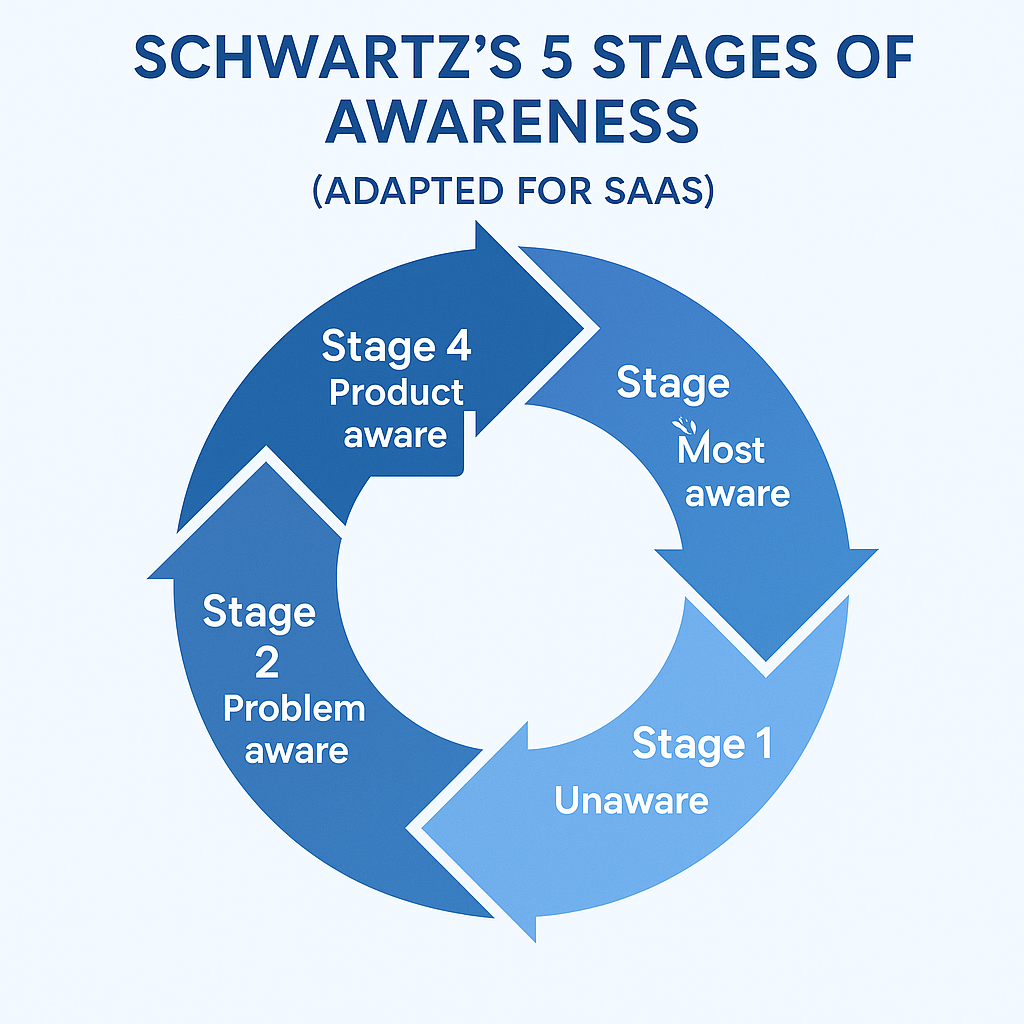
Here's how to apply it to SaaS marketing:
They're ready to buy your SaaS.
Make it easy to buy. (e.g., "Start your free trial now.")
Most SaaS companies make the mistake of only targeting the "Most Aware" 3%. They write copy that assumes the reader already knows they have a problem, knows a solution exists, and is just comparing options. That leaves 97% of the market on the table.
I worked with a healthcare SaaS company that was struggling to generate leads. Their homepage headline was "The #1 Patient Engagement Platform." That's fine for the 3% who are already looking for a patient engagement platform, but it means nothing to the 97% who don't even know that's a category. We changed the headline to "Are Your Patients Ghosting You After Their First Appointment?" We tapped into the problem they were already experiencing.
Here's another example for a cybersecurity SaaS. Say the original homepage was filled with technical jargon about "zero-trust architecture" and "advanced threat detection." These are important features, but they only resonate with the small percentage of prospects who are already deep in the buying process. I would immediately test these headlines on cold traffic landing pages: "Your team clicked on 47 phishing emails last month. You just don't know it yet." This taps into the fear and uncertainty that every CISO feels.
The lesson here is clear: meet your prospects where they are. If they're unaware, make them aware. If they're problem-aware, show them the solution. If they're solution-aware, prove you're the best. Don't write copy for where you want them to be. Write copy for where they actually are.
The Halbert Method: Finding Your "Starving Crowd" in the SaaS Marketplace
Gary Halbert, the author of The Boron Letters, was a master of finding and selling to a "starving crowd." He believed that the most important factor for success is a market with a desperate need.
Halbert would ask his students: "If you and I both owned a hamburger stand and we were in a contest to see who could sell the most hamburgers, what advantages would you most like to have on your side to help you win?"
Students would answer: better meat, better location, lower prices. Halbert would shake his head and say:
"The only advantage I want... is... A Starving Crowd!"
This principle is the foundation of all successful marketing. You can have the best product, the best copy, and the best offer, but if you're selling to people who don't want what you're selling, you'll fail.
How to Find (and Validate) Your Starving Crowd in B2B SaaS
To find your starving crowd, you need to listen. Here's where to look:
Online Communities: Reddit (e.g., r/SaaS, r/startups), industry forums, and Slack communities are goldmines of customer pain points. I spend at least an hour a week reading these communities, looking for patterns in what people are complaining about. When you see the same problem mentioned over and over again, you've found a starving crowd.
Review Sites: G2, Capterra, and TrustRadius are filled with complaints about your competitors. These are your opportunities. Look for 1-star and 2-star reviews and read them carefully. What are people frustrated about? What features are missing? What promises were broken? This is your roadmap for positioning your product as the better alternative.
Your Own Customer Support Tickets: Your customers are telling you what they need. Are you listening? I worked with a project management SaaS that was getting dozens of support tickets every week asking about a feature they didn't have. Instead of just adding it to the roadmap, we built an entire marketing campaign around it. We created a landing page that said "Tired of [Problem]? We built [Feature] just for you." That landing page converted at 18%, compared to their homepage which converted at 2.3%.
Another powerful source of insight is your sales team's call recordings. I recommend listening to at least 5-10 sales calls every month. Pay attention to the objections prospects raise, the questions they ask, and the language they use to describe their problems. This is pure gold for copywriting. Say that prospects keep asking "How long does implementation take?" during sales calls. I would add a section to their landing page that said "Up and running in 48 hours, not 48 days.". The copy addresses the objection before the prospect even had to ask. You can find pure gold in your sales and onboarding calls.
I've found that the best SaaS products are born from a founder's own frustration. They were part of the starving crowd and built the solution they couldn't find. If you're not sure whether you have a starving crowd, ask yourself: "Would I pay for this product if I didn't build it?" If the answer is no, you might not have a starving crowd (if you're reading this, I'm sure you do).
The Hopkins Method: Turning Your SaaS Marketing into a Science
Claude Hopkins, the author of "Scientific Advertising," was a pioneer of testing and measuring advertising effectiveness. He believed that advertising is salesmanship and should be treated as a science, not an art.
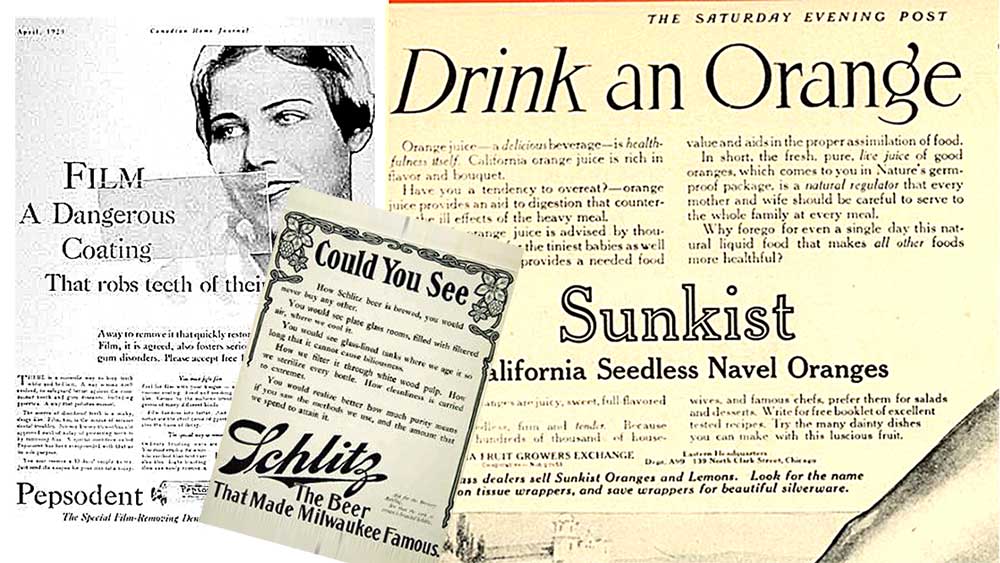
"The man who wins out and survives does so only because of superior science and strategy."
Hopkins was one of the first marketers to use coupons to track the effectiveness of different ads. He would run the same ad in different publications, each with a unique coupon code, and track which publications generated the most sales. This allowed him to know exactly which ads were working and which weren't.
"Test, Don't Guess": Applying Scientific Advertising to Your SaaS Funnel
In the digital age, we have an arsenal of tools to apply Hopkins' principles:
A/B testing tools: Optimizely, VWO
Analytics platforms: Google Analytics, Mixpanel
Heatmap and session recording tools: Hotjar, Crazy Egg
Let's take a look at an example. You want to test your CTA button text.
Here are your options:
- Variation 1: "Choose Your Plan"
- Variation 2: "Get Started Today"
- Variation 3: "Find the Perfect Plan for Your Team"
- Variation 4: "Start Growing Your Business"
- Variation 5: "Unlock All Features"
Which is the winner in your opinion? And why?
The winning headline is number four because it focused on the outcome (growing your business) rather than the action (choosing a plan). This is a small change, but it can make a massive difference when applied across your website.
The key to scientific advertising is to test everything. Even your CTAs. Don't assume you know what will work. Test your headlines, your CTAs, your images, your pricing, your onboarding flow. The market will tell you what works.
Here's a testing framework I use with every SaaS client:
Week 1-2: Baseline Measurement
- Set up tracking for all key metrics (visitor-to-lead, trial-to-paid, etc.)
- Document current performance
- Identify the biggest bottleneck in your funnel
Week 3-4: Hypothesis Generation
- Based on user research and competitor analysis, generate 3-5 hypotheses for improvement
- Prioritize based on potential impact and ease of implementation
Week 5-8: Testing
- Run A/B tests on your top 2-3 hypotheses
- Ensure you have statistical significance (at least 400-500 impressions per variation)
- Document results and learnings
Week 9-10: Implementation & Iteration
- Implement winning variations
- Start the cycle again with new hypotheses
The key is to make testing a habit, not a one-time event.
The Modern Direct Response SaaS Playbook
The Anatomy of a High-Converting SaaS Landing Page
A SaaS landing page is your digital salesperson. It needs to be persuasive, clear, and compelling. After analyzing hundreds of high-converting SaaS landing pages, I've identified the key elements that make them work:
Headline: The most important element. It must grab attention and make a promise. Use the 4 U's: Useful, Urgent, Unique, and Ultra-specific. A great headline answers the question: "What's in it for me?" in 10 words or less.
For example, Dropbox Business uses "Get more done, together." This is simple, benefit-focused, and speaks to their core value proposition: collaboration.
Sub-headline: Expands on the headline and provides more context. This is where you can add a bit more detail about what your product does and who it's for.
Hero Shot: An image or video that shows your product in action. This is critical for SaaS because your product is intangible. People need to see it to understand it. I recommend using a short demo video (30-60 seconds) that shows the key workflow of your product.
Social Proof: Testimonials, logos of well-known customers, and case studies are essential for building trust. According to research, showcasing logos from recognizable brands can increase conversions by as much as 400%. This is why you see logos from companies like Google, Amazon, and Microsoft on almost every SaaS landing page.
Benefits, Not Features: This is where most SaaS companies fail. They list features like "AI-powered analytics" or "24/7 customer support" without explaining what those features actually do for the customer. You need to translate what your product does into what your customer gets.
Call-to-Action (CTA): Your CTA should be clear, specific, and low-friction. Instead of a generic "Submit," use action-oriented language like "Start Your Free 14-Day Trial" or "See a Demo." I've found that CTAs that emphasize the value (e.g., "Get My Free Trial") convert better than CTAs that emphasize the action (e.g., "Sign Up").
The SaaS Conversion Copywriting Frameworks That Never Fail
These classic copywriting formulas are as effective today as they were 50 years ago. I use them in almost every piece of SaaS copy I write:
AIDA (Attention-Interest-Desire-Action):
This is the oldest and most widely used copywriting formula. It works because it mirrors the natural decision-making process.
- Attention: "Tired of manual data entry?"
- Interest: "Our tool automates your entire workflow in minutes."
- Desire: "Imagine saving 10 hours a week and focusing on what really matters."
- Action: "Start your free trial now."
PAS (Problem-Agitate-Solution):
This formula is particularly effective for SaaS because it taps into the pain points that your prospects are already experiencing.
- Problem: "Your sales team is spending too much time on admin tasks."
- Agitate: "That means less time selling, lower morale, and missed quotas."
- Solution: "Our CRM automates 90% of admin tasks so your team can focus on what they do best: selling."
The key is to really twist the knife in the "Agitate" section. Make them feel the pain before you offer the solution.
I see this as a common problem and get this question a lot:
"We're selling software, not something that requires DR copy. Why do we need it?"
Humans make decisions based on emotion, justified by logic. This is how you must treat your marketing, especially in SaaS. More logic, sure, but you NEED emotional copy too in order to resonate.
4 Ps (Promise-Picture-Proof-Push):
This is my personal favorite because it combines emotional appeal with hard evidence.
- Promise: "Double your sales team's productivity in 30 days."
- Picture: "Imagine your team hitting their numbers every single month, with less stress and more high-fives."
- Proof: "See how [Company X] increased their sales by 200% in the first quarter."
- Push: "Get a personalized demo today."
Beyond the Landing Page: Direct Response in SaaS Email Marketing
According to research, email marketing has an average ROI of $42 for every $1 spent, making it one of the most effective channels for SaaS companies. Here are the key sequences to master:
The Onboarding Sequence: Your most important email sequence. Guide users to their "aha!" moment as quickly as possible. Research shows that users who reach their "aha!" moment within the first 7 days are 3x more likely to convert to paid customers.
Here's the structure I use:
- Welcome Email (Day 0): Set expectations and provide a quick win.
- Tutorial Email (Day 1): Show them how to complete their first key action.
- Value Email (Day 3): Share a case study or success story.
- Check-in Email (Day 5): Ask if they need help and offer a demo.
- Urgency Email (Day 7): Remind them of their trial expiration and offer an incentive to upgrade.
The Trial Expiration Sequence: Create urgency and overcome objections to drive conversions. I've found that a 3-email sequence works best:
- 7 Days Before Expiration: "Your trial is ending soon. Here's what you'll lose."
- 3 Days Before Expiration: "Last chance to lock in your discount."
- Day of Expiration: "Your trial expires today. Upgrade now to keep your data."
The Churn Reduction Sequence: Win back customers who are about to leave with a compelling offer. This is one of the most underutilized sequences in SaaS. I've seen churn reduction sequences save 20-30% of customers who were about to cancel.
The most successful SaaS email sequences all have one thing in common: they focus on the user's success, not the product's features. Every email should answer the question: "How does this help me achieve my goal?"
Let me give you a concrete example. Let's say you operate a marketing automation SaaS that hads a 14-day free trial. Currently, your onboarding email sequence is purely educational: "Here's how to set up your first campaign," "Here's how to create a segment," etc.
I would rewrite the entire sequence to focus on outcomes instead of features. Here's what we changed:
Old Email 1: "Welcome to [Product]! Here's how to get started." New Email 1: "You're 3 steps away from your first 100 leads."
Old Email 3: "How to create your first email campaign." New Email 3: "Sarah used this exact campaign to generate $50K in revenue. Here's how to copy it."
Old Email 7: "Your trial is halfway done. Need help?" New Email 7: "You've generated 47 leads so far. Here's how to double that by Friday."
Focus on what the user can achieve, not what the product can do.
Becoming a Direct Response SaaS Master
The Direct Response SaaS Marketing Stack
To execute a direct response strategy effectively, you need the right tools. Here's a look at the modern SaaS marketing stack:
Landing Page Builders: Unbounce, Leadpages, and Instapage are excellent for quickly creating and testing high-converting landing pages. I personally use Unbounce because of its robust A/B testing capabilities.
Email Marketing Platforms: HubSpot, Mailchimp, and ActiveCampaign provide the automation and segmentation capabilities you need to run effective email campaigns. If you're just starting out, I recommend Mailchimp for its ease of use. If you need more advanced automation, go with ActiveCampaign.
Analytics & Testing Tools: Google Analytics, Mixpanel, Optimizely, and Hotjar are essential for understanding user behavior and testing your hypotheses. Google Analytics is the baseline, but Mixpanel gives you much more granular insights into user behavior.
CRM: HubSpot and Salesforce are the industry leaders for managing customer relationships and tracking the entire sales funnel. HubSpot is more user-friendly and better for smaller teams, while Salesforce is more powerful and better for enterprise.
The Metrics That Matter: How to Measure What Works
Direct response marketing is all about measurable results. Here are the key metrics you need to track:
Conversion Rate (by stage): Visitor-to-lead, lead-to-trial, and trial-to-paid conversion rates are the vital signs of your marketing funnel. The average visitor-to-lead conversion rate for SaaS companies is around 2.1% for SEO and 2.2% for LinkedIn. If you're below these benchmarks, you need to optimize your landing pages and CTAs.
For context, here's what a healthy SaaS funnel looks like based on industry data:
- Visitor to Lead: 2-3%
- Lead to MQL: 40-45%
- MQL to SQL: 40-50%
- SQL to Opportunity: 40-50%
- Opportunity to Close: 35-40%
Customer Acquisition Cost (CAC): This is the total cost of acquiring a new customer. It's a critical metric for understanding the efficiency of your marketing spend. To calculate CAC, divide your total sales and marketing expenses by the number of new customers acquired in that period.
Lifetime Value (LTV): This is the total revenue a customer generates over their lifetime. A high LTV is a sign of a healthy business. To calculate LTV, multiply your average revenue per user (ARPU) by your average customer lifetime.
CAC:LTV Ratio: This is the golden ratio of SaaS. A healthy business should have a CAC:LTV ratio of at least 3:1, meaning for every dollar you spend to acquire a customer, you get at least three dollars back in lifetime value. If your ratio is below 3:1, you're spending too much on acquisition or not retaining customers long enough.
Real-World SaaS Copywriting Examples That Convert
Let me show you some real-world examples of SaaS companies that are nailing direct response copywriting:
HubSpot CRM: "Start growing for free."
This headline is brilliant because it combines the promise of growth with zero-cost entry. It addresses the two biggest objections for early-stage users: cost and risk.
Grammarly Business: "Your words matter. Make them count."
This is a perfect example of emotional appeal paired with actionable benefit. It triggers self-awareness and positions the product as the solution.
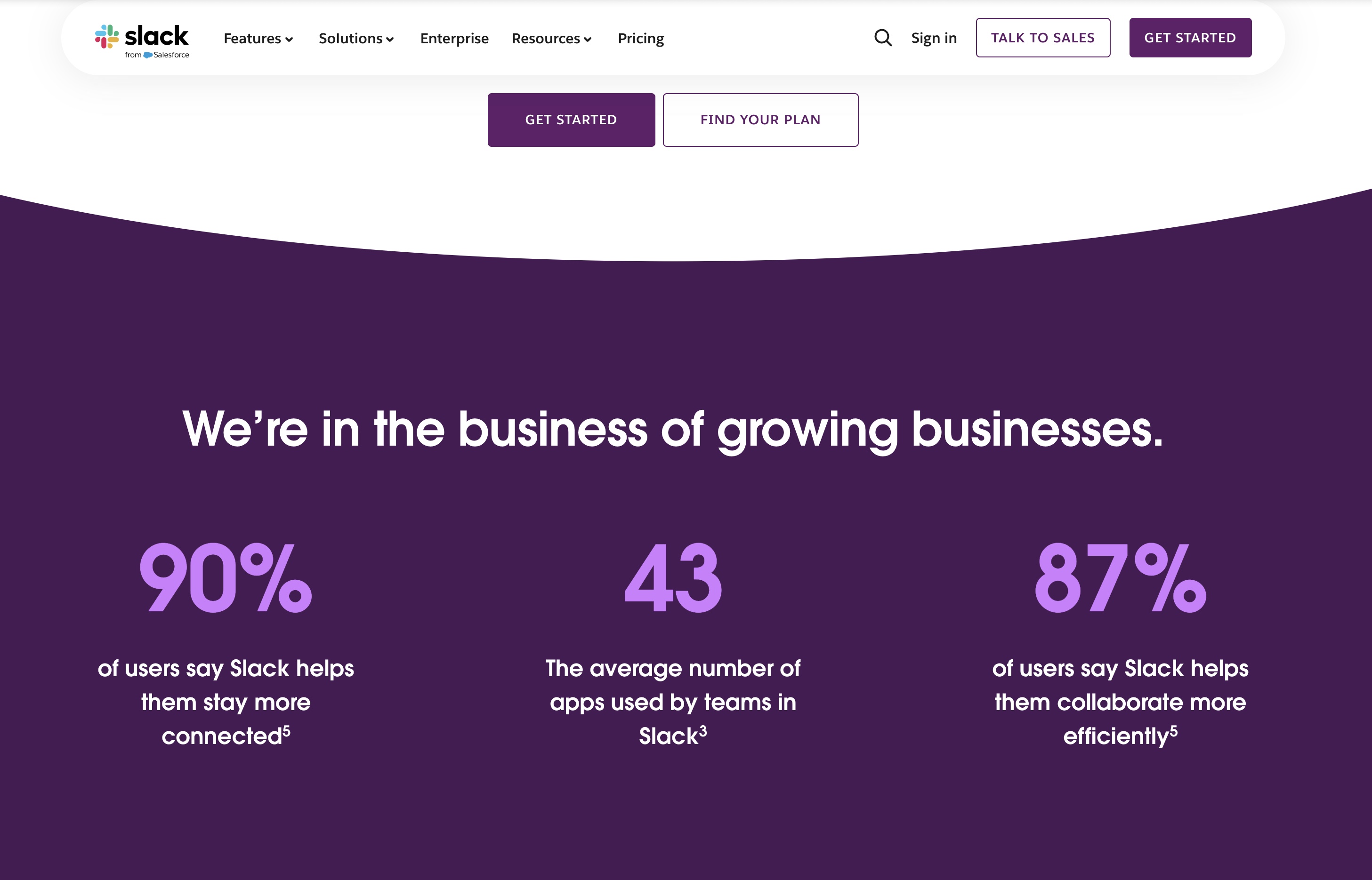
Slack: "Unlock your team's full potential."
This headline suggests transformation by upgrading, without being overly technical. It's aspirational and benefit-focused.
Notion: "Your workspace, your way."
This puts control in the user's hands and appeals to customization lovers. It's simple but powerful.
Your Personal Journey to Direct Response Mastery
Becoming a master of direct response copywriting is a lifelong journey. Here's how to continue your education:
Read the Classics: "Breakthrough Advertising" by Eugene Schwartz, "Scientific Advertising" by Claude Hopkins, and "The Boron Letters" by Gary Halbert are the foundational texts of direct response. I've read each of these books at least three times, and I learn something new every time.
Hand-Copy Great Ads: This is one of the best ways to internalize the rhythm and structure of great copy. Take a classic ad (like the Wall Street Journal's "Two Young Men" ad) and copy it by hand. This forces you to slow down and really understand why each word was chosen.
Build a Swipe File: Collect examples of great copywriting that you can reference for inspiration. I have a folder on my computer with hundreds of landing pages, emails, and ads that I've saved over the years. Whenever I'm stuck, I go through my swipe file and look for patterns.
Test Everything: Never assume you know what will work. The market is the ultimate judge. I've been writing copy for 6 years, and I'm still surprised by what works and what doesn't. Especially on cold traffic. The only way to know is to test.
The Future of SaaS is Direct Response
The principles of direct response are timeless because they are rooted in human psychology. In the fast-changing world of SaaS, they are more important than ever. The SaaS companies that will win the next decade are the ones that obsess over their customers' needs and use the principles of direct response to meet them. Having the most effective message is more important than having the most features.
I've seen this play out over and over again in my 6 years working with B2B SaaS companies. The companies that grow the fastest aren't the ones with the biggest marketing budgets or the most advanced technology. They're the ones that understand their customers deeply and communicate with them in a way that resonates.
Direct response copywriting gives you the framework to do this systematically. It's not about being clever or creative for the sake of it. It's about understanding what your customers want, what they fear, and what will motivate them to take action. Then, it's about testing and measuring everything to find out what actually works.
The beauty of direct response is that it's democratic. You don't need a massive budget to compete. You just need to understand your customers better than your competitors do and communicate with them more effectively. A small SaaS startup with great copy can outperform a well-funded competitor with mediocre messaging.
What's one thing you can test this week? Pick one element of your landing page or one email in your onboarding sequence and apply one of the principles from this guide. Change your headline to focus on benefits instead of features. Add social proof to your pricing page. Test a new CTA that emphasizes value instead of action. Apply the 5 Stages of Awareness to your homepage and see if you can capture a wider audience.
Then, let me know what happens. I'd love to hear your results. The best part about direct response is that you'll know within days or weeks whether it's working. You don't have to wait months to see if your brand awareness campaign is paying off. You can see the results immediately in your conversion rates, your trial sign-ups, and your revenue.
That's the power of direct response copywriting for SaaS. It's measurable, it's scalable, and it works.