

![[headshot] image of customer (for a pr firm)](https://cdn.prod.website-files.com/69232909ef27bc15ca57c9ec/692415a73f3948330046438a_linkedinprofilephoto.png)
How to Write for Technical Buyers: A Guide to Conversion Copywriting for Complex Products
Writing for technical buyers is a tightrope walk. Lean too far into marketing, and you lose credibility with a skeptical audience that despises fluff. Lean too far into technical jargon, and you alienate the non-technical decision-makers who control the budget. I’ve navigated this challenge for years, crafting copy for complex products in healthcare SaaS, crypto/Web3, and enterprise software.
This guide is my playbook. It’s a framework for writing compelling copy that makes complex products understandable and desirable without dumbing them down. We’ll cover how to earn trust, translate features into value, and ultimately, convert the most discerning buyers on the planet. Whether you’re selling healthcare SaaS, crypto infrastructure, or enterprise software, these principles will help you craft copy that resonates with technical audiences and drives real business results.
Deconstructing the Technical Buyer’s Mindset
Before you can write a single word that converts, you have to understand the unique psychology of the technical buyer. These aren’t your average consumers. They’re engineers, developers, IT managers, and product leaders who are deeply skeptical, highly analytical, and allergic to marketing fluff. A Gartner report found that 83% of software buyers change their initial vendor list after doing their own research, which tells you they are not easily swayed by a flashy homepage.
The Skepticism is Real (and Earned)
Technical buyers have been burned before. They’ve seen countless products that promised the world and delivered a buggy, over-hyped mess. As a result, they approach every new product with a healthy dose of skepticism. Your copy needs to acknowledge this skepticism and work to overcome it. This is where the principles of persuading a hyper-skeptical audience become critical.

I once worked with a Web3 infrastructure company that was struggling to get traction. Their copy was full of the typical crypto buzzwords: “decentralized,” “trustless,” “permissionless.” It was a classic case of marketing to themselves. We rewrote their entire website to focus on the tangible benefits of their platform: faster transaction speeds, lower gas fees, and enhanced security. We also added a “Technical Deep Dive” section to each feature page that provided the nitty-gritty details that developers crave. The result? A 200% increase in sign-ups for their private beta.
They Speak a Different Language
Technical buyers have their own language, and it’s not the language of marketing. They don’t care about your “synergies” or your “paradigm shifts.” They care about your API documentation, your integration capabilities, and your security protocols. Your copy needs to speak their language. This doesn’t mean you should fill your copy with jargon, but it does mean you need to understand the technical nuances of your product and be able to communicate them clearly and accurately.
They Value Substance Over Style
While a beautiful design is always a plus, technical buyers are far more interested in the substance of your product than the style of your website. They want to see a clear, concise explanation of what your product does, how it works, and why it’s better than the competition. They want to see a demo, a free trial, and detailed documentation. They want to kick the tires and see for themselves if your product is as good as you claim it is. A study by HubSpot found that 96% of people watch explainer videos to learn more about a product, and this is especially true for technical buyers.
The Buying Committee: A Multi-Headed Beast
In the world of B2B software, you’re rarely selling to a single person. You’re selling to a buying committee that can include anywhere from 6 to 10 stakeholders. This committee can include:
- The Economic Buyer: The person who signs the check (e.g., the CFO, the CEO).
- The Technical Buyer: The person who evaluates the technical merits of your product (e.g., the CTO, the lead engineer).
- The User Buyer: The person who will actually use your product on a day-to-day basis (e.g., a developer, a project manager).
- The Champion: The person who is advocating for your product internally.
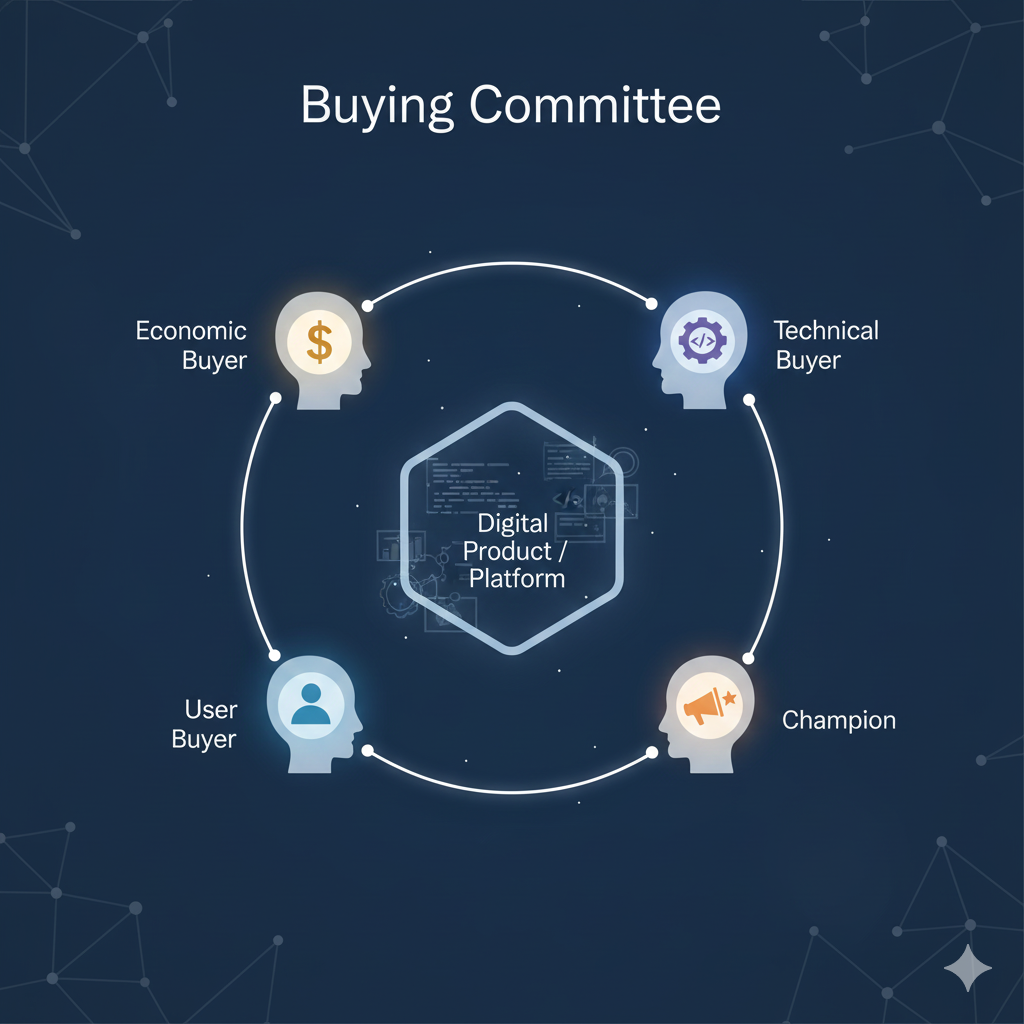
Your copy needs to speak to all of these different stakeholders. This means you need to have a clear value proposition for each of them. Let's break down how to do that:
- For the Economic Buyer (CFO, CEO): This person cares about the bottom line. Your copy should focus on the financial benefits of your product. Use phrases like "reduce costs by X%," "increase revenue by Y%," and "achieve a Z% ROI." Provide case studies with clear financial metrics. A great example is Salesforce's customer stories, which are packed with impressive ROI numbers.
- For the Technical Buyer (CTO, Lead Engineer): This person cares about the technology. Your copy should focus on the technical superiority of your product. Use phrases like "built on a modern architecture," "integrates seamlessly with your existing stack," and "best-in-class security." Provide detailed technical documentation, a free trial, and a sandbox environment where they can test your product.
- For the User Buyer (Developer, Project Manager): This person cares about ease of use. Your copy should focus on how your product will make their life easier. Use phrases like "intuitive interface," "streamlined workflow," and "get started in minutes." Provide tutorials, getting-started guides, and a responsive customer support team.
- For the Champion: This person is your internal advocate. Your copy should arm them with the information they need to sell your product internally. This includes a clear value proposition, a competitive analysis, and a list of key features and benefits. A well-structured internal one-pager can be a powerful tool for your champion.
How to Research Your Technical Audience
So how do you get inside the heads of your technical buyers? Here are some of the methods I use:
- Talk to your sales team. Your sales team is on the front lines, talking to potential customers every day. They have a wealth of knowledge about your target audience’s pain points, objections, and motivations. I recommend sitting in on sales calls and demos to hear it for yourself.
- Talk to your customer support team. Your customer support team is another great source of information about your target audience. They know what your customers are struggling with, what they love about your product, and what they wish it could do.
- Read online reviews. Online review sites like G2 and Capterra are a goldmine of information about your target audience. You can see what your customers are saying about your product, as well as your competitors’ products.
- Hang out where your audience hangs out. Where does your target audience spend their time online? Are they on Reddit? Hacker News? Stack Overflow? Find out where they are and go there. Listen to their conversations. See what they’re talking about. This is a great way to get a feel for their language, their culture, and their pain points.
- Conduct customer interviews. There’s no substitute for talking to your customers directly. I recommend conducting at least 5-10 customer interviews before you start writing any copy. Ask them about their role, their goals, their challenges, and how they use your product. You’ll be amazed at what you learn.
The Technical Copywriting Playbook
Now that you understand the mindset of the technical buyer, let’s talk about how to write copy that converts them. This is the playbook I’ve used to help dozens of technical companies turn their websites into lead-generation machines.
The Core Principle: Clarity Above All Else
When it comes to technical copywriting, clarity is king. Your copy needs to be so clear that a non-technical person can understand it, but so detailed that a technical person will respect it. This is a delicate balance, but it’s the key to success. As the technical writing experts at Document360 say, "Keep it simple".
One of the best ways to achieve clarity is to use the “explain it to a 5-year-old” technique. Before you start writing, try to explain your product to someone who has no technical background. If you can’t do it, then you don’t understand your product well enough to write about it.
The Psychology of Reading Technical Content
It’s also important to understand how people read technical content. A study by the Nielsen Norman Group found that people rarely read web pages word for word. Instead, they scan the page, looking for keywords and phrases that are relevant to their interests. This is especially true for technical content, which can be dense and difficult to read.
This means you need to make your copy as scannable as possible. Here are some tips:
- Use short sentences and paragraphs.
- Use headings and subheadings to break up your text.
- Use bullet points and numbered lists.
- Use bold and italics to highlight key points.
I also recommend using a tool like Hemingway Editor to check the readability of your copy. This tool will highlight long, complex sentences and common errors. It’s a great way to ensure your copy is as clear and concise as possible.
The Value-First Messaging Framework
Technical buyers don’t care about your features; they care about what your features can do for them. This is why you need to use a value-first messaging framework. This framework involves translating your features into quantifiable business outcomes. Here’s how it works:
I once worked with a healthcare SaaS company that had a brilliant product for managing clinical trials. But their website was a mess. It was a laundry list of features that nobody understood. We rewrote their entire website using the value-first messaging framework. We focused on the tangible benefits of their product: faster patient recruitment, lower trial costs, and improved data quality. The result? A 400% increase in demo requests.
Here’s another example. I worked with an enterprise software company that was selling a complex data analytics platform. Their homepage was a wall of text that was impossible to understand. We redesigned their homepage to focus on a single, compelling headline: “The Data Analytics Platform That’s as Easy to Use as a Spreadsheet.” We then used a series of short, punchy subheadings to highlight the key benefits of the platform. We also added a short, 2-minute explainer video that showed the platform in action. The result? A 60% increase in free trial sign-ups.
The Art of the Technical Deep Dive
While your high-level messaging should be focused on value, you also need to provide the technical details that your audience craves. This is where the “technical deep dive” comes in. A technical deep dive is a detailed explanation of how a particular feature works. It can be a separate page on your website, a section on a feature page, or even a downloadable whitepaper. The goal is to provide enough detail to satisfy the most technical members of the buying committee. For a great example of this, check out the technical documentation for Stripe.
Social Proof: The Ultimate Trust Signal
Technical buyers are a skeptical bunch. They’re not going to take your word for it that your product is great. They want to see proof. This is where social proof comes in. Social proof can take many forms:
- Case Studies: Detailed stories of how your customers have used your product to achieve real results.
- Testimonials: Short quotes from happy customers.
- Customer Logos: A list of well-known companies that use your product.
- Reviews: Ratings and reviews from third-party sites like G2 and Capterra.
I recommend using a combination of all of these types of social proof on your website. The more proof you can provide, the more trust you’ll build with your audience.
The Power of Storytelling
Even the most technical buyers are susceptible to a good story. Stories are how we make sense of the world, and they’re a powerful tool for building an emotional connection with your audience. A study by neuroeconomist Paul Zak found that our brains release oxytocin, the “trust hormone,” when we hear a compelling story.
So how do you tell a story about a technical product? Here are a few ideas:
- The Origin Story: Every company has an origin story. Why was the company founded? What problem did the founders set out to solve? This is a great way to humanize your brand and connect with your audience on a personal level. A great example is the origin story of Airbnb.
- The Customer Story: We’ve already talked about the importance of case studies, but you can also tell customer stories in a more narrative format. Instead of just listing the results, tell the story of how your customer went from a state of struggle to a state of success. What were their challenges? What were their goals? How did your product help them achieve those goals? This is a great way to make your case studies more engaging and memorable.
- The Product Story: Every product has a story. How was it built? What challenges did the team overcome? What’s the vision for the future? This is a great way to give your audience a behind-the-scenes look at your company and to build a sense of community around your product.
One of my clients, a B2B SaaS company in the logistics space, was struggling to compete with a much larger, more established competitor. We decided to make social proof the centerpiece of their marketing strategy. We created a dedicated “Customer Stories” section on their website that featured in-depth case studies with their most successful customers. We also sprinkled testimonials throughout their website and created a “Wall of Love” on their homepage that featured a live feed of positive tweets about their product. The result? They were able to increase their conversion rate by 25% and close a number of large enterprise deals that they had been struggling to land.
Channel-Specific Best Practices
Not all copy is created equal. The copy you write for your homepage is going to be very different from the copy you write for a technical whitepaper. Here are some channel-specific best practices to keep in mind:
Website Copy: Your Digital Storefront
Your website is your digital storefront. It’s often the first impression a potential customer will have of your brand. Your website copy needs to be clear, concise, and compelling. It needs to quickly communicate your value proposition and guide visitors to the next step in the buying process. The average B2B conversion rate for websites is around 2-5%, so every word counts.
I recommend using the AIDA formula for your website copy:
- Attention: Grab the visitor’s attention with a bold headline.
- Interest: Pique their interest with a compelling subheading.
- Desire: Create desire with a list of benefits and social proof.
- Action: Tell them what to do next with a clear call to action.
For a masterclass in website copywriting, check out the homepage for Slack. It’s a perfect example of how to communicate a complex product in a simple, compelling way.
A/B Testing: The Secret to High-Converting Copy
Even the best copywriters in the world don’t get it right on the first try. That’s why A/B testing is so important. A/B testing is the process of testing two different versions of a piece of copy to see which one performs better. It’s the only way to know for sure what’s working and what’s not.
I recommend A/B testing everything from your headlines and your calls to action to your pricing and your testimonials. Even small changes can have a big impact on your conversion rate. A study by VWO found that one company was able to increase their conversion rate by 40% just by changing the color of their call-to-action button.
Tools like Optimizely and Google Optimize make it easy to run A/B tests on your website. I recommend running at least one A/B test per month. It’s the fastest way to learn what resonates with your audience and to continuously improve your conversion rate.
Common Mistakes to Avoid
Even with the best intentions, it’s easy to make mistakes when writing for a technical audience. Here are some of the most common pitfalls I see:
- Using too much jargon. While you need to speak the language of your audience, you don’t want to alienate them with a wall of acronyms and buzzwords. When in doubt, spell it out.
- Focusing on features instead of benefits. This is the cardinal sin of technical copywriting. Always remember to translate your features into tangible benefits for your customers.
- Being too formal. Technical buyers are people too. Don’t be afraid to inject some personality into your copy. A conversational tone can go a long way in building trust and rapport.
- Hiding your pricing. This is a huge red flag for technical buyers. They want to know how much your product costs, and they don’t want to have to jump through hoops to find out. Be transparent with your pricing, and you’ll earn their respect.
- Making it hard to get help. When a technical buyer has a question, they want an answer now. Make it easy for them to get help by providing a comprehensive knowledge base, a responsive support team, and a community forum where they can connect with other users.
Landing Pages: The Conversion Machines
Landing pages are all about conversion. They’re designed to get visitors to take a specific action, whether it’s signing up for a free trial, downloading a whitepaper, or requesting a demo. Your landing page copy needs to be laser-focused on that one goal. Remove all distractions and make it as easy as possible for visitors to convert. Unbounce has a great guide to creating high-converting landing pages.
Email Copy: The Relationship Builder
Email is one of the most powerful tools in your marketing arsenal. It’s a great way to build relationships with potential customers and nurture them through the sales cycle. Your email copy should be personal, helpful, and conversational. Don’t be afraid to show some personality. People buy from people, not from robots. For some great examples of B2B email copywriting, check out the emails from Close.
Technical Documentation: The Hero of Conversion
Technical documentation is often an afterthought for marketers, but it’s one of the most important pieces of content you can create. Your documentation is where your technical buyers will spend most of their time. It’s where they’ll go to learn how to use your product, how to integrate it with their existing systems, and how to troubleshoot any issues they run into. Your documentation needs to be clear, comprehensive, and easy to navigate. A great example of technical documentation is the documentation for Twilio.
Blog Content: The SEO Powerhouse
Your blog is the engine of your SEO strategy. It’s where you’ll create the content that will attract your target audience and drive them to your website. Your blog content should be a mix of top-of-funnel, middle-of-funnel, and bottom-of-funnel content. For a deep dive on this, check out my guide to SaaS SEO content strategy. And if you want to learn more about applying classic direct response principles to your SaaS copywriting, check out my guide to direct response copywriting for SaaS.
Video: The Ultimate Conversion Tool
Video is one of the most powerful tools in your copywriting arsenal. A Wyzowl report found that 88% of people have been convinced to buy a product or service by watching a brand’s video. And when it comes to technical products, video is even more important. It’s the best way to show your product in action and to explain complex concepts in a simple, visual way.
Here are some of the types of videos I recommend creating:
- Product Demos: A product demo is a short video that shows your product in action. It’s a great way to give potential customers a feel for what it’s like to use your product.
- Explainer Videos: An explainer video is a short, animated video that explains what your product does and how it works. It’s a great way to communicate a complex value proposition in a simple, engaging way.
- Customer Testimonials: A customer testimonial video is a short video that features a happy customer talking about their experience with your product. It’s a powerful form of social proof that can go a long way in building trust with your audience.
- Webinars: A webinar is a live, online event where you can educate your audience about a particular topic and then pitch your product at the end. It’s a great way to generate leads and to build relationships with potential customers.
Advanced Conversion Tactics for Technical Products
Once you’ve mastered the fundamentals of technical copywriting, you can start to experiment with more advanced conversion tactics. These are the strategies that can take your conversion rate from good to great.
Crafting High-Converting Pricing Pages
Your pricing page is one of the most important pages on your website. It’s where potential customers go to make a final decision about whether or not to buy your product. A well-designed pricing page can have a huge impact on your conversion rate. A study by Price Intelligently found that companies that optimize their pricing pages can increase their revenue by 25% or more.
Here are some tips for crafting a high-converting pricing page:
- Keep it simple. Don’t overwhelm your visitors with too many options. I recommend offering no more than 3-4 pricing tiers.
- Use value-based pricing. Don’t just list your features. Group your features into tiers that are aligned with the needs of your different customer segments.
- Highlight your most popular plan. Use a visual cue, like a different color or a “Most Popular” banner, to draw attention to the plan you want most people to choose.
- Offer a free trial or a money-back guarantee. This is a great way to reduce the risk for potential customers and to increase your conversion rate.
- Include social proof. Add testimonials and customer logos to your pricing page to build trust and credibility.
For a great example of a high-converting pricing page, check out the pricing page for HubSpot.
Winning with Competitive Comparison Pages
Your potential customers are going to compare you to your competitors. It’s inevitable. Instead of shying away from this, you should embrace it. Create a competitive comparison page that shows how your product stacks up against the competition. This is a great way to control the narrative and to highlight your unique selling proposition.
Here are some tips for creating a winning competitive comparison page:
- Be honest. Don’t try to hide your weaknesses or to exaggerate your strengths. Your audience will see right through it. Be honest about where you’re strong and where you’re weak.
- Focus on what matters. Don’t just create a laundry list of features. Focus on the key differentiators that matter most to your target audience.
- Use a table. A table is a great way to present a lot of information in a clear, concise way. Use a table to compare your features, your pricing, and your customer support to your competitors.
- Include a clear call to action. At the end of your comparison page, tell your visitors what to do next. Should they sign up for a free trial? Request a demo? Contact your sales team?
For a great example of a competitive comparison page, check out the comparison page for Wistia.
Building a Community to Drive Long-Term Growth
In the world of B2B software, community is everything. A strong community can be a powerful engine for growth. It can help you to attract new customers, to retain existing customers, and to build a brand that people love. A study by Leader Networks found that 88% of companies with online communities have seen a positive impact on their business.
Here are some tips for building a community around your technical product:
- Create a dedicated space for your community to gather. This could be a forum on your website, a Slack channel, or a Discord server.
- Be an active participant. Don’t just create a community and then walk away. Be an active participant. Answer questions, share resources, and facilitate conversations.
- Empower your community members. Your community members are your biggest advocates. Empower them to help each other, to share their knowledge, and to become leaders in the community.
- Reward your community members. Recognize and reward your most active community members. This could be anything from a shout-out on social media to a free t-shirt to a discount on your product.
For a great example of a company that has built a strong community around their technical product, check out the community for Figma.
Speak Their Language, Earn Their Trust
Writing for technical buyers is a unique challenge, but it’s also a huge opportunity. By understanding their mindset, speaking their language, and earning their trust, you can turn your website into a powerful engine for growth. Elevate your communication. And respect your audience enough to give them the information they need, in a way that they can understand and appreciate. Do that, and you’ll not only win their business, but you’ll also win their respect.
A Final Word on Authenticity
I want to leave you with one final thought: be authentic. Technical buyers can smell a fake a mile away. Don’t try to be something you’re not. Don’t try to be the “cool” brand if that’s not who you are. Be yourself. Be honest. Be transparent. And most importantly, be helpful. If you do that, you’ll be well on your way to building a brand that technical buyers love.
Over the years, I’ve written copy for some of the most complex products imaginable. From healthcare SaaS platforms that manage clinical trials to crypto infrastructure that powers decentralized applications, I’ve seen firsthand what works and what doesn’t.
The companies that succeed are the ones that respect their audience, provide real value, and communicate with clarity and precision. They understand that technical buyers are smart, discerning, and skeptical, and they craft their copy accordingly. That’s the secret to winning in the world of technical copywriting.