

![[headshot] image of customer (for a pr firm)](https://cdn.prod.website-files.com/69232909ef27bc15ca57c9ec/692415a73f3948330046438a_linkedinprofilephoto.png)
How to Write Technical Content That Ranks AND Converts

Technical content marketing is a tightrope walk. Lean too far into marketing, and you lose credibility with a skeptical audience that despises fluff. Lean too far into technical jargon, and you alienate the non-technical decision-makers who control the budget. I’ve navigated this challenge for years, crafting copy for complex products in healthcare SaaS, crypto/Web3, and enterprise software.
This guide is my playbook. It’s a framework for writing compelling copy that makes complex products understandable and desirable without dumbing them down. We’ll cover how to earn trust, translate features into value, and ultimately, convert the most discerning buyers on the planet.
Whether you’re selling healthcare SaaS, crypto infrastructure, or enterprise software, these principles will help you craft copy that resonates with technical audiences and drives real business results.
The Core Challenge: The Two-Audience Problem
Every technical content marketer faces the same fundamental challenge: you’re writing for two completely different audiences at the same time.
- The Technical Audience (Engineers, Developers): This group craves depth, accuracy, and detail. They want to see code snippets, architectural diagrams, and API documentation. They have a low tolerance for marketing fluff and can spot inaccuracies from a mile away. As I detailed in my guide to technical product copywriting, this audience values substance over style.
- The Business Audience (VPs, Directors, C-Suite): This group cares about business outcomes. They want to know how your product will help them increase revenue, reduce costs, or gain a competitive advantage. They don’t have time to wade through dense technical jargon. They need to quickly understand the value proposition and the ROI.
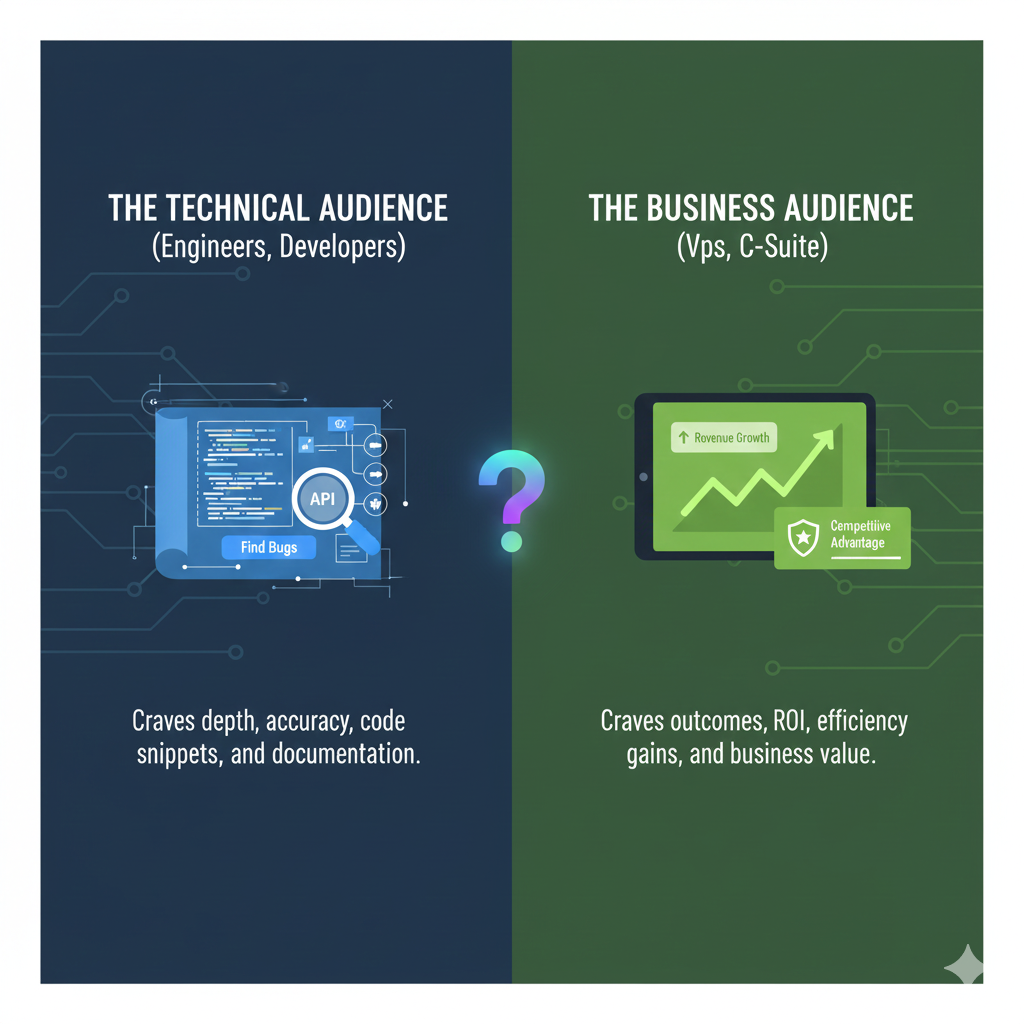
Your content needs to satisfy both. Fail to provide enough technical detail, and you’ll lose the trust of the engineers. Fail to communicate the business value, and you’ll never get buy-in from the decision-makers. This is the tightrope walk of technical content marketing, and mastering it is the key to success. For example, a blog post about a new API feature might include a high-level summary of the business benefits at the top for the business audience, followed by detailed code snippets and a link to the full API documentation for the technical audience. This way, you’re providing value to both audiences without alienating either one. I once worked with a data analytics company that was struggling to get traction with their blog. Their content was either too technical for their business audience or too simplistic for their technical audience. We implemented a new content strategy that involved creating two different types of content: high-level, thought leadership pieces for the business audience, and in-depth, technical tutorials for the technical audience. The result was a 300% increase in organic traffic and a 50% increase in marketing qualified leads (MQLs).
Pillar 1: Audience-Centric Content Strategy
Before you write a single word, you need to have a deep understanding of both your technical and business audiences. This goes beyond simple demographics. You need to understand their pain points, their goals, their motivations, and their preferred channels for consuming content.
Building Your ICP and Personas
I’ve written extensively about the importance of building a detailed Ideal Customer Profile (ICP) and buyer personas in my SaaS SEO Content Strategy guide. For technical content, it’s even more critical. You should have distinct personas for your primary technical and business buyers.
For a cybersecurity client, we developed two key personas. This process involved weeks of interviews with their sales team, customer support reps, and existing customers. We also spent countless hours lurking on the online forums where their target audience hangs out. The result was a deep understanding of their customers' needs, which allowed us to create content that truly resonated. We discovered that their technical audience was deeply concerned about the performance impact of security tools, while their business audience was primarily focused on compliance and reporting. This insight allowed us to create two distinct content streams that addressed each audience's specific concerns. For the technical audience, we created a series of blog posts on topics like 'How to Reduce False Positives in Your SIEM' and 'A Deep Dive into the MITRE ATT&CK Framework.' For the business audience, we created a series of blog posts on topics like 'The ROI of a Modern Security Operations Center' and 'How to Build a Business Case for a New SIEM.'
- “Security Sam” (Technical Persona): A Senior Security Engineer with 8 years of experience. He’s skeptical of new tools, values deep technical documentation, and spends his time on Reddit’s /r/netsec and Hacker News. His biggest pain point is the flood of false positives from their current security tools.
- “Decision-Maker Diane” (Business Persona): A VP of IT with a team of 20. She’s focused on reducing the risk of a data breach, staying within her budget, and proving the ROI of her security investments. She reads industry publications like Dark Reading and attends webinars from trusted sources.
Having these detailed personas allowed us to create content that spoke directly to each of their needs. For Sam, we created in-depth tutorials and technical whitepapers. For Diane, we created high-level blog posts and ROI calculators.
The “Jobs to be Done” Framework
The “Jobs to be Done” (JTBD) framework is another powerful tool for understanding your audience. Instead of focusing on who your customers are, JTBD focuses on what they’re trying to accomplish. A great resource on this is the book “When Coffee and Kale Compete.” This framework forces you to think about the underlying motivation behind a user's search.
For example, a developer searching for 'how to set up a CI/CD pipeline' isn't just looking for a tutorial. They're trying to 'ship code faster and with fewer errors.' Framing your content around this 'job' makes it infinitely more valuable.
Another example: a data scientist searching for 'how to build a recommendation engine' isn't just looking for code snippets. They're trying to 'increase user engagement and reduce churn.'
Your content should speak to that higher-level goal. When you do this, you’re not just providing a solution to a technical problem; you’re helping your audience to achieve their business goals. This is how you build trust and credibility with a technical audience.
For example, a developer isn’t just “looking for a new API.” They’re trying to “build a new feature that will delight their users” or “reduce the time it takes to ship new code.” By understanding the job to be done, you can create content that’s more relevant and compelling.
Pillar 2: The Technical Content SEO Blueprint
Great technical content is useless if nobody can find it. That’s why you need a solid SEO strategy. But technical SEO is different from traditional SEO. You’re not just trying to rank for high-volume keywords; you’re trying to attract a highly specific, highly technical audience.
Keyword Research for a Technical Audience
Your keyword research process needs to be tailored to your technical audience. This means going beyond the standard keyword research tools and digging into the places where your audience hangs out online. Here are some of the methods I use:
- Community Mining: I spend hours on Reddit, Hacker News, Stack Overflow, and other online communities where developers and engineers hang out. I look for the questions they’re asking, the problems they’re struggling with, and the language they’re using. This is a goldmine of keyword ideas. I’ve found some of my most valuable keywords by simply paying attention to the language people use when they’re describing their problems. For example, I once discovered that a client's target audience was using the term 'data gravity' to describe a problem that the client was solving. We created a piece of content around that term, and it quickly became one of their top-performing assets.
- Competitor Analysis: I use tools like Ahrefs and Semrush to see what keywords my competitors are ranking for. But I don’t just look at their marketing pages; I also look at their documentation, their tutorials, and their technical blog posts.
- “Vs.” Keywords: Technical buyers are always comparing different products and technologies. That’s why “vs.” keywords (e.g., “Docker vs. Kubernetes,” “AWS vs. Azure”) are so valuable. These keywords have high purchase intent and can drive a lot of qualified traffic.
Structuring Your Content for Readability and SEO
Once you have your keywords, you need to structure your content in a way that’s both readable and SEO-friendly. This is where the balancing act between technical depth and readability really comes into play. Here are some tips:
- The Inverted Pyramid: Start with the most important information first. Your business audience will appreciate the high-level summary, and your technical audience can always dig deeper into the details.
- The “Skim, Scan, and Read” Model: Most people don’t read web pages word for word. They skim the headlines, scan the subheadings, and then read the parts that are most relevant to them. Structure your content accordingly. Use short paragraphs, bullet points, and bold text to make your content easy to scan. The Nielsen Norman Group has a great article on this.
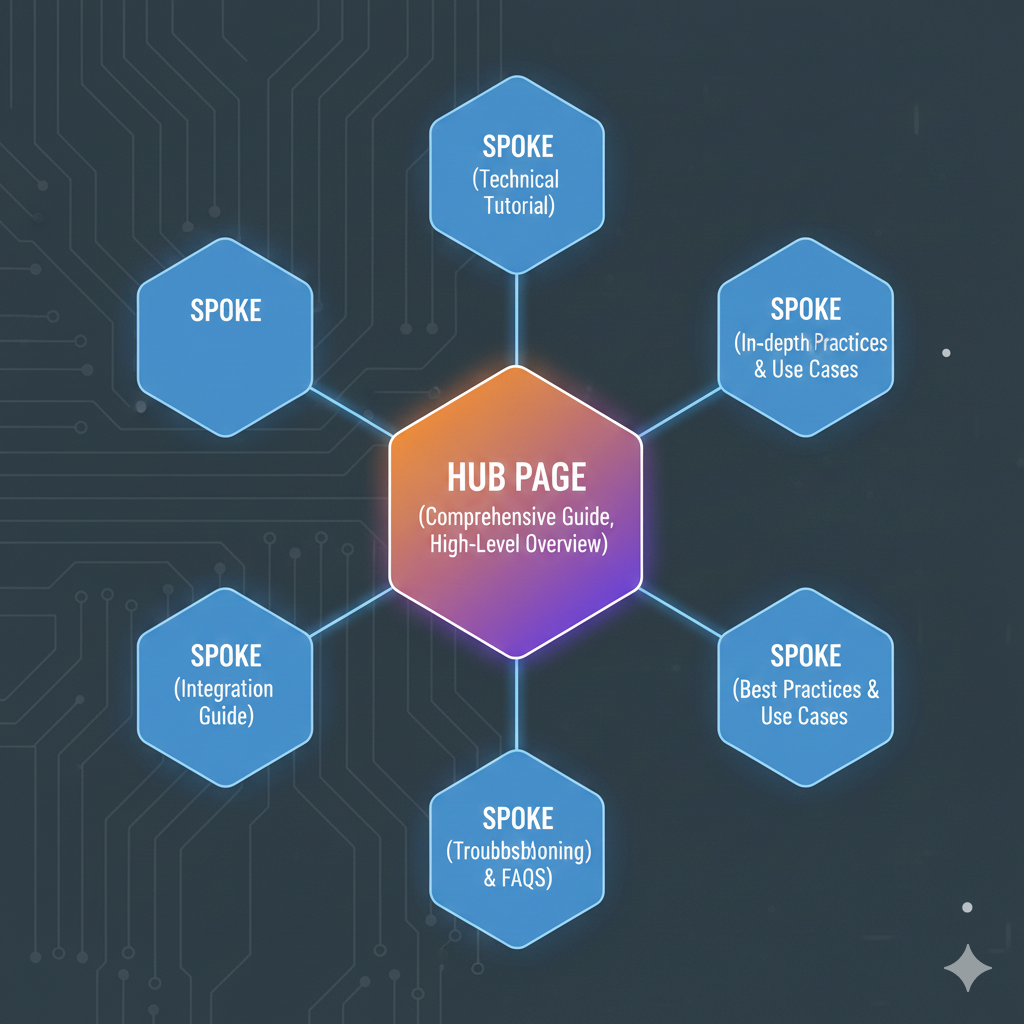
- The “Hub and Spoke” Model: For complex topics, I recommend using the “hub and spoke” model. The “hub” is a long-form pillar page that provides a high-level overview of the topic. The “spokes” are shorter, more detailed articles that link back to the hub. This is a great way to organize your content and to build topical authority. For example, our SaaS SEO Content Strategy guide is a hub page, and this article is one of the spokes. This structure helps search engines understand the relationship between your content and establishes your site as an authority on the topic. It also creates a better user experience by allowing readers to easily navigate between high-level overviews and deep-dive tutorials. For example, you could create a hub page on 'The Ultimate Guide to Containerization' and then create spoke pages on topics like 'Docker vs. Kubernetes,' 'How to Set Up a Docker Swarm,' and 'A Guide to Container Security.'
Pillar 3: The Conversion-Focused Writing Process
Now that you have your strategy in place, it’s time to start writing. This is where the rubber meets the road. Here’s the process I use to create technical content that ranks and converts.
The Features to Benefits to Outcomes Framework
I’ve written a whole article on my Features to Benefits to Outcomes framework, but here’s the short version:
- Features: What your product does.
- Benefits: Why it matters to the user.
- Outcomes: The tangible business results.
Most technical content stops at features. Good content talks about benefits. Great content focuses on outcomes. For example:
The Art of the Analogy
Analogies are one of the most powerful tools in a technical writer’s toolbox. They allow you to explain complex concepts in a simple, relatable way.
For example, when explaining the concept of a container, you could use the analogy of a shipping container. It’s a standardized unit that can be moved from place to place without affecting the contents inside. This is a much more intuitive explanation than a dry, technical definition.
The goal is to build a bridge from the known to the unknown. Find something your audience already understands and use it as a stepping stone to explain your complex topic.
For example, when explaining the concept of a blockchain, you could use the analogy of a shared, distributed ledger. It’s a simple analogy, but it’s surprisingly effective at explaining a complex topic.
Another example: when explaining the concept of an API, you could use the analogy of a waiter in a restaurant. The waiter takes your order (the request), brings it to the kitchen (the server), and then brings you your food (the response). It’s a simple way to explain a complex interaction.
The Power of Visuals
They say a picture is worth a thousand words, and when it comes to technical content, that’s definitely true. Visuals can help to break up long blocks of text, to explain complex concepts, and to make your content more engaging. Here are some of the types of visuals I recommend using:
- Screenshots and GIFs: Show your product in action.
- Architectural Diagrams: Help your audience understand how your product works.
- Infographics: Present data in a visually appealing way.
- Videos: A Wyzowl report found that 88% of people have been convinced to buy a product or service by watching a brand’s video.
Pillar 4: Advanced Technical Content Formats
Once you've mastered the basics of technical blogging, you can start to experiment with more advanced content formats. These formats are a great way to capture leads, to build thought leadership, and to move prospects down the funnel.
Whitepapers and Ebooks
Whitepapers and ebooks are long-form, gated content assets that allow you to do a deep dive on a particular topic. They're a great way to generate leads and to establish your company as a thought leader in your space. A 2023 report from the Content Marketing Institute found that 71% of B2B marketers use whitepapers and ebooks in their content marketing.
Here are some tips for creating successful whitepapers and ebooks:
- Choose a topic that's relevant to your audience. Your whitepaper or ebook should solve a specific problem for your target audience. Don't just rehash the same old information. Provide a unique perspective or a new solution.
- Make it data-driven. The best whitepapers and ebooks are packed with data and research. Use charts, graphs, and statistics to back up your claims.
- Design it professionally. Your whitepaper or ebook should be well-designed and easy to read. Use a professional designer to create a custom layout and to make sure your content is visually appealing.
Webinars
Webinars are a great way to connect with your audience in a live, interactive setting. They're a great way to generate leads, to build relationships with potential customers, and to demo your product. A 2024 report from GoToWebinar found that the average webinar attendance rate is 46%.
Here are some tips for hosting a successful webinar:
- Choose a compelling topic. Your webinar topic should be something that your target audience is interested in learning about.
- Promote your webinar heavily. Use email, social media, and paid ads to get the word out about your webinar.
- Make it interactive. Encourage your audience to ask questions and to participate in polls. The more interactive your webinar is, the more engaged your audience will be.
- Follow up with attendees. Send a follow-up email to everyone who registered for your webinar. Include a link to the recording and a special offer for attendees.
Technical Case Studies
We've already talked about the importance of social proof, but technical case studies take it to the next level. A technical case study is a deep dive into how a specific customer is using your product to solve a real-world problem. It's a powerful way to show, not just tell, how your product works.
Here are some tips for creating a compelling technical case study:
- Choose a customer that your target audience can relate to. Your case study will be more effective if your audience can see themselves in the customer's shoes.
- Tell a story. Don't just list the facts. Tell the story of how your customer went from a state of struggle to a state of success. What were their challenges? What were their goals? How did your product help them achieve those goals?
- Include real data and metrics. The more data you can include, the more credible your case study will be. Include metrics like ROI, cost savings, and performance improvements.
Pillar 5: Content Distribution and Promotion
Creating great content is only half the battle. You also need to make sure it gets in front of the right people. This is where content distribution and promotion come in. Here are some of the channels I use to promote technical content:
- Social Media: I share all of my technical content on LinkedIn and Twitter. I also share it in relevant LinkedIn groups and on my personal profile. The key is to not just drop a link and run. You need to add some context and start a conversation.
- Online Communities: I share my content on Reddit, Hacker News, and other online communities where my target audience hangs out. But I don’t just spam the link. I look for relevant conversations and then share my content as a helpful resource. This is a great way to drive traffic and to build credibility.
- Email Marketing: I have a newsletter that I send out to my subscribers every week. I always include a link to my latest technical article in my newsletter. This is a great way to drive repeat traffic to your website and to build a loyal audience.
- Paid Promotion: If you have a budget, paid promotion can be a great way to get your content in front of a larger audience. I’ve had a lot of success with LinkedIn ads and Twitter ads. The key is to target your ads very specifically to your target audience. For example, on LinkedIn, you can target your ads to people with specific job titles, skills, and interests. On Twitter, you can target your ads to people who follow specific accounts or who have used specific hashtags.
Why It’s a Marathon, Not a Sprint
Creating technical content that ranks and converts is not a one-time project; it’s an ongoing process. It requires a deep understanding of your audience, a solid SEO strategy, and a commitment to creating high-quality, valuable content. But if you’re willing to put in the work, the payoff can be huge. By following the strategies outlined in this guide, you can create a technical content engine that drives qualified traffic, generates leads, and helps you win in the competitive world of B2B SaaS. Remember, the goal is not just to rank; it's to convert. And that requires a deep understanding of your audience, a commitment to quality, and a willingness to experiment and iterate over time. I’ve seen clients go from having a handful of blog posts to having a full-fledged content engine that generates millions in pipeline. It’s a lot of work, but it’s worth it.
A Note on Patience
One final thought: be patient. Technical content marketing is a long game. It can take months, or even years, to see the full ROI of your efforts. But if you’re consistently creating high-quality, valuable content, you will see results. The key is to stay the course and to not get discouraged if you don’t see a huge spike in traffic overnight. It’s a marathon, not a sprint. The good news is that the rewards are well worth the effort. A single, well-written technical article can continue to drive traffic and leads for years to come. It’s the gift that keeps on giving. I have articles that I wrote years ago that still drive thousands of visitors to my website every month. That’s the power of technical content marketing.
Measuring Your Success
One final note on patience: it’s important to measure your success along the way. This will help you to stay motivated and to make sure you’re on the right track. Here are some of the metrics I use to measure the success of my technical content:
- Organic Traffic: This is the most obvious metric, but it’s also one of the most important. Are you seeing an increase in organic traffic to your website? Are you ranking for your target keywords?
- Leads and MQLs: Are you generating leads and marketing qualified leads (MQLs) from your technical content? This is the ultimate measure of success.
- Engagement Metrics: Are people spending time on your pages? Are they scrolling down to the bottom? Are they leaving comments? These are all good signs that your content is resonating with your audience.
- Backlinks: Are other websites linking to your content? This is a great sign that your content is valuable and authoritative.
By tracking these metrics, you can get a good sense of what’s working and what’s not. This will allow you to double down on what’s working and to cut what’s not. It’s a continuous process of improvement, but it’s the only way to build a successful technical content engine.